


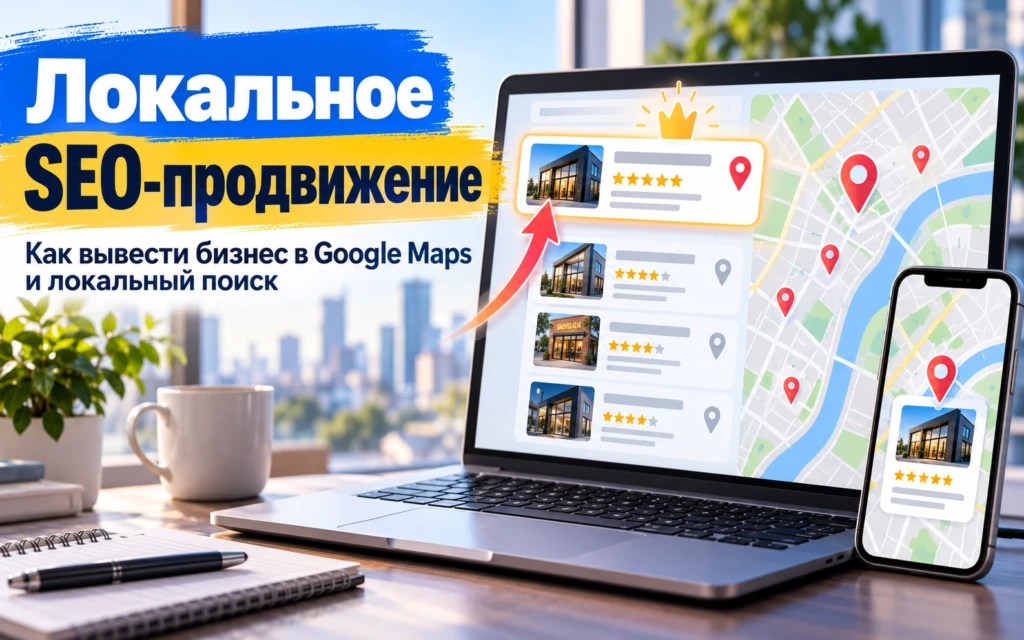
Local SEO promotion helps a company appear on Google when a potential customer searches for a nearby service in a particular city or neighborhood. It combines website optimization, Google Business Profile, local landing pages, reviews, and trustworthy business mentions across external platforms. The result is not random traffic but inquiries from people already prepared to call, request directions, book a service, or visit the listed address at a convenient time.
What Is Local SEO Promotion in Simple Terms?
Local SEO is a coordinated set of activities that improves business visibility for location-dependent searches such as “dentist in Odesa,” “barbershop near me,” “printing company Kyiv,” or “device repair in Pozniaky.” Google considers the words in the query, the searcher’s location, and available company information, then builds both the standard organic results and the local map pack.
Unlike broad SEO, the goal is not merely to rank a website for a service-related phrase. The search engine must clearly understand what the company offers, where it operates, which areas it serves, and whether its address, opening hours, and contact details are reliable. That is why a website and its Google Business Profile should be developed as one connected system.
Who Needs SEO for a Local Business?
Local promotion is particularly important for companies that meet customers at an office, salon, clinic, store, or defined service area. It works for dental practices, medical centers, beauty salons, barbershops, restaurants, garages, printing companies, law firms, repair specialists, and other services linked to a specific city or neighborhood.
Location can influence a purchase even when the order is completed online. A customer may compare delivery times, pickup availability, the nearest branch, and feedback from people in the same city. Local SEO optimization is therefore useful not only for physical locations but also for regional online stores, delivery services, and multi-location companies.
How Does Google Determine Local Search Rankings?
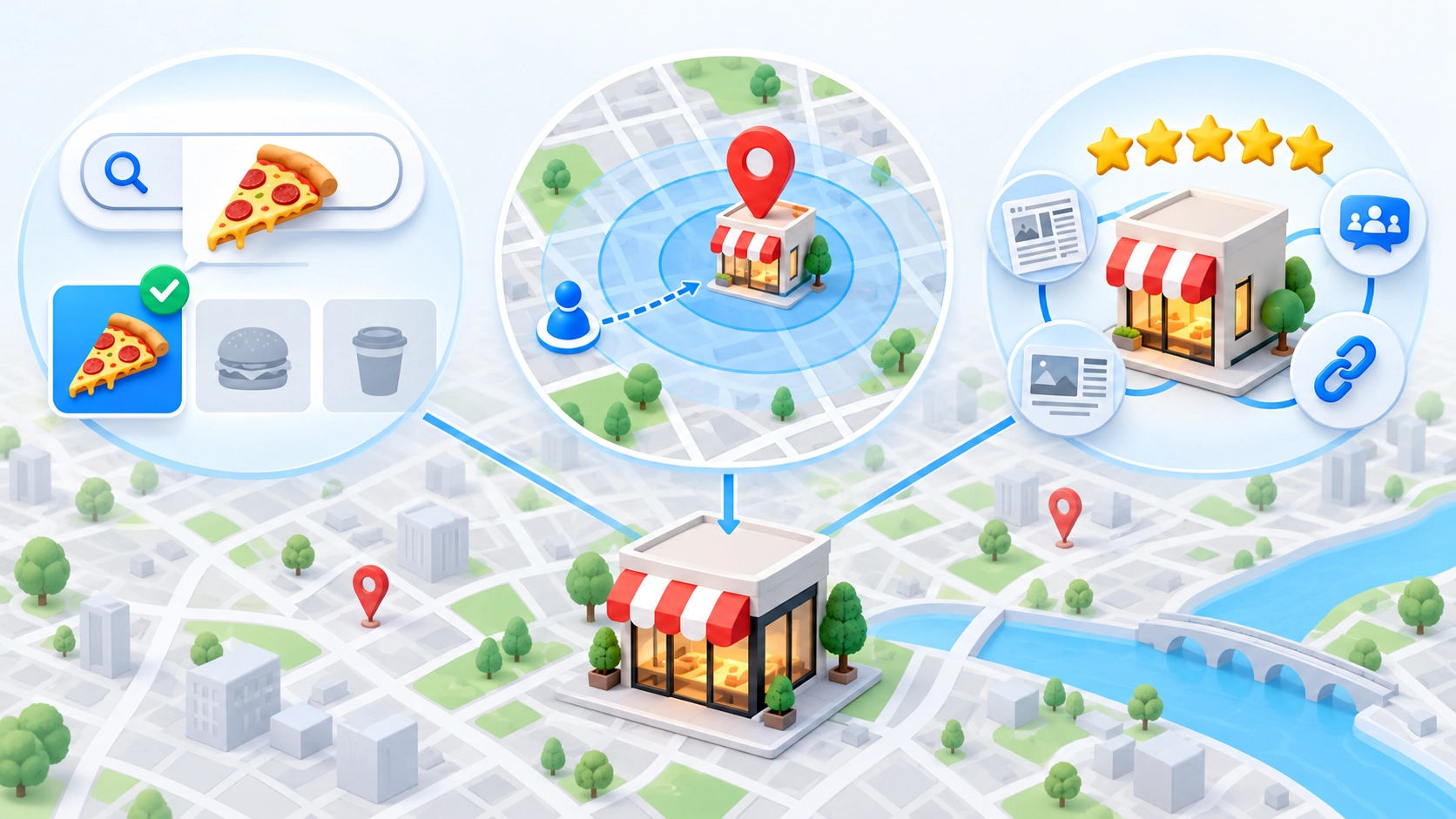
Google identifies three main groups of factors: relevance, distance, and prominence. Relevance describes how closely the profile and website match the query. Distance concerns the space between the searcher and the business, or the place specified in the query. Prominence reflects reviews, links, citations, data completeness, and the company’s broader authority across the web.
A business cannot change its physical distance from every searcher, but it can improve other signals. This involves selecting accurate Google Business Profile categories, completing service information, keeping the business name, address, and phone number consistent, building useful landing pages, and managing reviews. The fewer contradictions Google encounters, the easier it is to connect the company with a relevant search.
How Do You Promote a Local Business on Google?
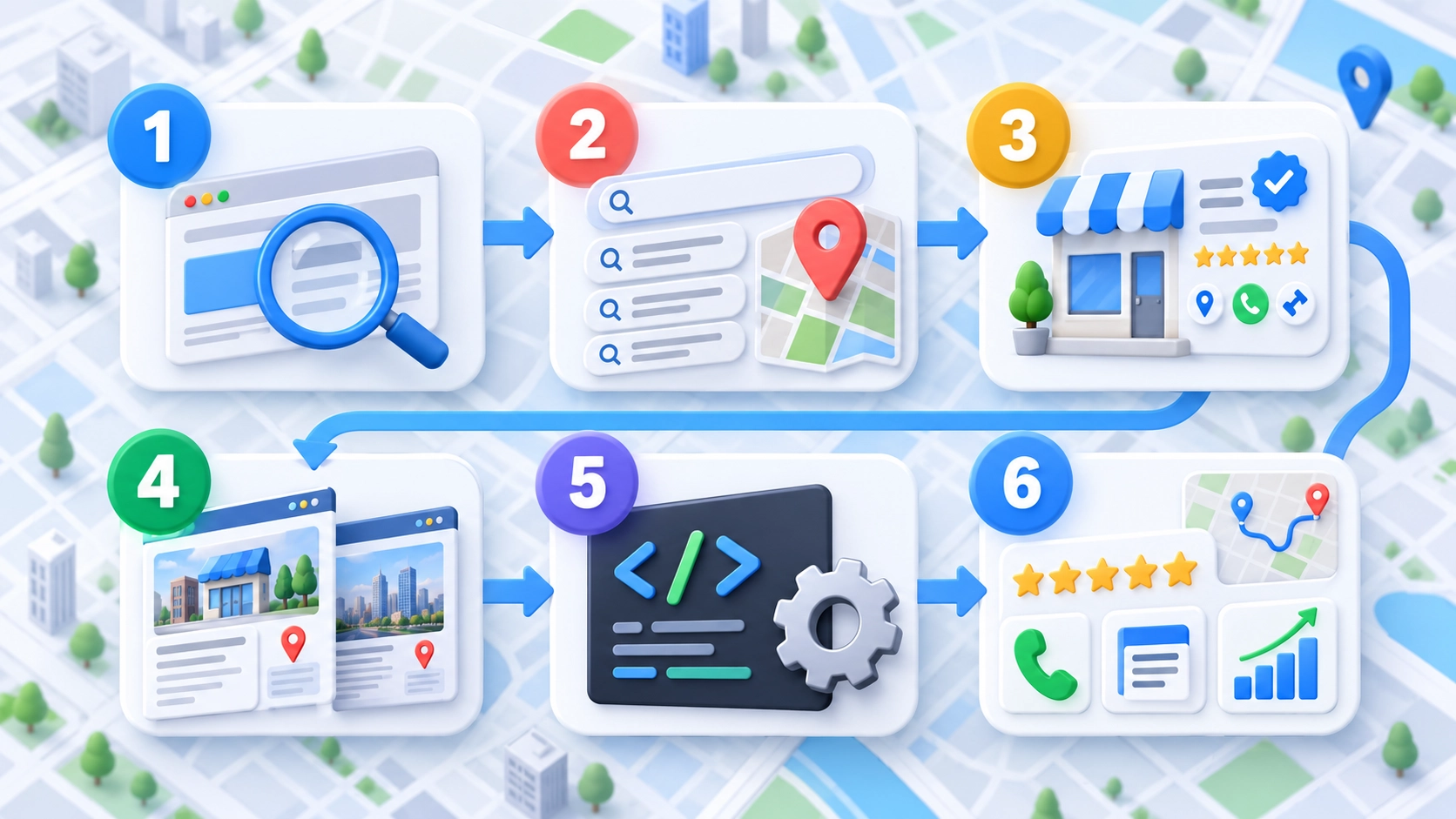
1. Run a Local SEO Audit
The process begins by checking indexing, technical errors, site structure, mobile usability, loading speed, the business profile, and current rankings. Competitors in organic search and Google Maps should also be reviewed, including their categories, service pages, reviews, links, and keyword coverage. The audit reveals what is limiting growth and which actions deserve priority.
2. Build a Local Keyword Structure
Queries should be grouped by service, city, neighborhood, and user intent. Phrases such as “dentist Odesa,” “dentist Slobidka,” and “dental implant price Odesa” should not be placed thoughtlessly on one page; they may require different sections or separate landing pages. A well-organized keyword map defines the future site structure and prevents pages from competing with one another.
3. Optimize the Google Business Profile
The profile should contain the current business name, primary and secondary categories, address or service area, phone number, website, opening hours, services, description, photos, and contact options. These details must match the website. Adding unnecessary keywords to the business name or creating fake addresses violates Google’s rules and can result in profile restrictions.
4. Create Service and Location Pages
Every priority service needs a page with a clear H1, pricing or an explanation of how cost is calculated, workflow, timing, examples, location details, and answers to common questions. If the company operates several genuine branches, each can have a unique page with its own contacts, directions, photos, and local details. Copying the same text and changing only the city name is not a useful strategy.
5. Strengthen Technical and Local Website Signals
Search crawlers must be able to access important pages, text, and links. The audit should cover robots.txt, sitemaps, canonicals, redirects, language versions, indexing status, and mobile rendering. The website should display consistent contact details, a map, opening hours, and LocalBusiness structured data. Markup helps Google interpret information accurately, although it does not guarantee a high ranking by itself.
6. Earn Reviews and Local Mentions Consistently
Reviews affect trust and help customers choose between nearby alternatives. Feedback should be requested after a genuine visit or completed order without offering rewards for a positive rating. Every review deserves a calm, specific response. Accurate listings in industry directories, city guides, and editorial mentions on relevant local websites can further strengthen the company’s online footprint.
How Can a Business Rank Higher in Google Maps?
There is no single button or one-time setting that guarantees a top map position. The company should remove duplicate profiles, complete verification, choose the right category, list its services, and keep opening hours current. The linked website must load quickly on mobile devices and provide a page relevant to the main service and location.
Rankings should be checked across a geographic grid because results can change within the same neighborhood. A manual check from the office shows only one point and cannot represent the entire service area. Meaningful reporting combines map visibility with calls, website visits, direction requests, forms, bookings, and completed sales instead of focusing only on an average position.
How Do Local Landing Pages Attract Customers from Different Areas?
A local page answers a practical question: can the customer get the required service at this location? It should therefore include more than a geographic keyword. Useful elements include an address, nearby landmarks, parking or delivery information, opening hours, prices, team members, original branch photos, and a clear call to action. This serves the visitor better than repeated mentions of a city and neighborhood.
A single-location business does not need dozens of nearly identical pages for surrounding districts. It is better to describe the genuine location and its services thoroughly. A multi-location company can create one unique page for each branch and a city hub connecting them. This makes navigation clearer and reduces the risk of duplicate or competing content.
A Real Local SEO Promotion Case Study
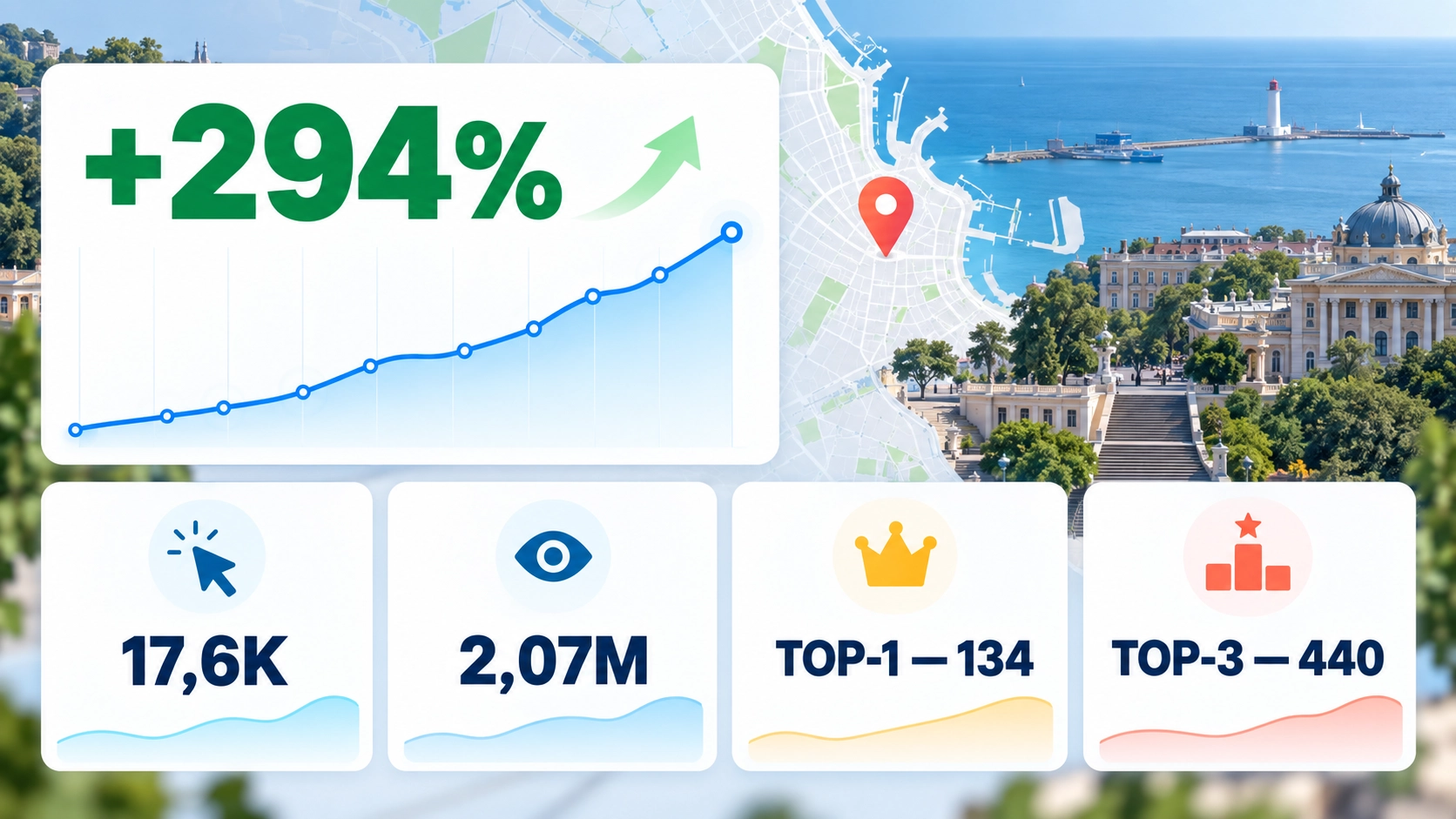
Local SEO results are best evaluated over a meaningful period. In our Odesa dental SEO case study, annual organic traffic increased by 294%, from 3,581 to 14,097 sessions. During the latest 12-month period, the website received 17,600 clicks and 2.07 million impressions in Google Search Console; 134 queries reached the top position and 440 ranked in the top three.
No single adjustment produced this growth. We improved site structure, commercial service pages, local keyword coverage, expert content, internal linking, technical health, and external signals. A consistent process expands overall search visibility and earns visits from queries that reflect a customer’s real need rather than superficial traffic.
How Long Does Local SEO Take?
Initial movement may appear after corrected pages are recrawled and profile updates are processed, but sustainable growth usually takes several months. Timing depends on the age of the website, competition, technical condition, number of branches, profile history, and consistency of execution. A new business typically needs more time than an established company with a trusted website, reviews, and existing citations.
SEO cannot be judged by the statement “we added keywords.” A campaign needs baselines and clear KPIs: non-branded visibility, neighborhood-level rankings, organic clicks, Google Business Profile actions, calls, forms, bookings, and cost per inquiry. Performance should be compared across equivalent periods while accounting for seasonality.
How Much Does Local SEO Cost?
Pricing is calculated after an audit. It depends on the number of services, cities, and branches; the condition of the website; the volume of technical development; and the need for new pages, content, or backlinks. Promoting one local company is fundamentally different from managing a network of dozens of locations, so a universal package offered without analysis may not reflect the actual workload.
A transparent proposal explains the activities, priorities, review schedule, and reporting format. The client should understand what has been completed, how visibility has changed, and how many qualified inquiries organic search has generated. The purpose of local SEO is not an abstract increase in traffic but more customers from the intended city or service area.
FAQ: Common Questions About Local SEO
What Is the Difference Between Local SEO and Regular SEO?
Regular SEO may target an entire country or a broad subject, while local SEO connects a service with a city, neighborhood, or the searcher’s nearby location. In addition to the website, it relies heavily on Google Business Profile, map visibility, consistent contact details, reviews, location pages, and trustworthy mentions on regional websites.
Can You Rank in Google Maps Without a Website?
A profile can appear without a website, but its reach and ability to explain the offer are limited. A website presents services, prices, expertise, case studies, and answers while improving relevance for a wider set of searches. In a competitive market, an optimized website combined with Google Business Profile usually provides a more durable foundation.
Does Every Neighborhood Need a Separate Page?
No. A separate page is unnecessary when the business has no genuine branch or unique offering for that area. Publishing large numbers of identical pages with only the location name changed creates duplication and little value. A location page is justified when it contains a unique address, contacts, directions, staff, services, photos, and other verifiable details.
How Do You Know Whether Local SEO Is Working?
Measure the complete path: growth in non-branded visibility, search clicks, profile actions, calls, direction requests, forms, bookings, and sales. Rankings should also be checked from different points in the city. This approach separates genuine improvement in local demand from a temporary increase in informational traffic that does not produce customers.
Can Anyone Guarantee the First Position in Google Maps?
No one can guarantee a fixed first position because results depend on the searcher’s location, competition, relevance, and business prominence. Professional local SEO improves controllable factors, corrects errors, and expands visibility. A responsible provider evaluates progress using reliable data instead of promising the same position for every search query and address.
Order Local SEO Services
If your website is not bringing customers from the intended city, start with an audit of local results, Google Business Profile, and landing pages. Okeycompany will create a strategy, prioritize the work, and connect SEO activity with measurable inquiries. Submit a request to identify your strongest growth opportunities and the issues that should be corrected first.

