



Dental clinic SEO is the coordinated improvement of a website’s technical health, service pages, local visibility, expert content, and online reputation. Its purpose is to make the clinic visible in Google for searches such as “dentist near me,” “dental implant cost,” or “children’s dentist,” attract qualified visits, and turn those visits into calls, enquiries, and confirmed appointments rather than traffic with no commercial value.
Why is dental clinic website promotion different from ordinary SEO?
A patient does not choose a dental practice only because its website ranks first. People compare dentists, qualifications, equipment, treatment methods, prices, reviews, location, and appointment availability. Adding keywords to a page is therefore not enough. The website must answer the search, demonstrate that the clinic is competent and trustworthy, and help a concerned patient make an informed decision.
Dental demand is also strongly local. Google may use the searcher’s location even when no city or district appears in the query. According to Google’s official guidance, local results are mainly based on relevance, distance, and prominence. That is why local SEO promotion for a dental clinic must connect the website, Google Business Profile, patient reviews, and consistent third-party mentions.
What is included in dental SEO services?
A sound strategy is a connected program of work, not a single page edit. Its scope depends on the condition of the website, number of treatments, competition in the target city, number of locations, and the domain’s history. A standard dental SEO campaign includes:
- a technical SEO audit and correction of indexing problems;
- research and clustering of real patient search queries;
- a site structure for services, cities, districts, and locations;
- Google Business Profile and contact-data optimization;
- expert content prepared with the clinic’s dentists;
- internal linking and the development of relevant external links;
- tracking for calls, forms, and appointment requests;
- monthly monitoring of rankings, traffic, and conversions.
How do you promote a dental clinic website in Google?
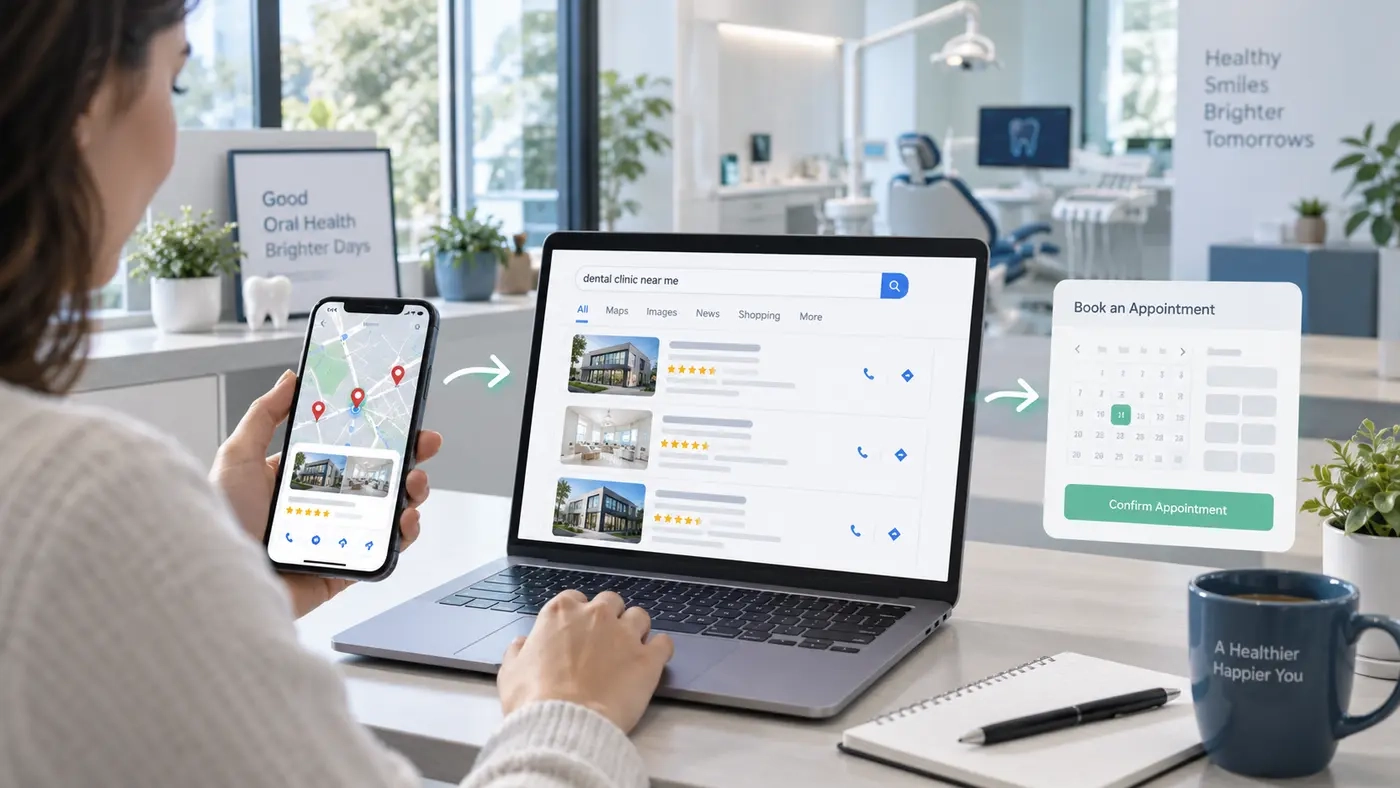
1. Begin with a technical SEO audit
The first step is to confirm that Google can crawl, render, and index every important page. The audit covers robots.txt, XML sitemaps, canonical tags, redirects, duplicate URLs, language versions, 404 errors, loading speed, mobile usability, and Core Web Vitals. If a treatment page is blocked from indexing, declares the wrong canonical URL, or hides its useful content behind unreliable JavaScript, publishing more copy will not solve the underlying problem.
The same audit should examine the patient experience. A visitor using a phone must be able to see the telephone number, appointment button, address, dentist, price information, and practical conditions without searching through multiple menus. Technical optimization is not about achieving an isolated PageSpeed score; it is about removing obstacles before a visitor leaves the page or abandons a form.
2. Build the keyword map around services and intent
Queries should be grouped by patient need, not only by search volume. “Dentist in Odesa,” “wisdom tooth removal,” “single dental implant price,” and “what to do with tooth pain” express different intentions. They require a city or homepage, dedicated service landing pages, and educational articles respectively.
Clustering prevents several pages from competing for the same topic. High-volume phrases belong in the most relevant headings and sections, not in every paragraph. The purpose of keyword research is to create a clear website architecture and cover the patient journey from an early question to an appointment, while keeping each page focused on one main purpose.
3. Create dedicated pages for each dental service
Implants, root canal treatment, professional cleaning, orthodontics, prosthodontics, pediatric dentistry, and oral surgery should not be compressed into one general page. Each priority treatment needs its own landing page explaining indications, stages, timing, price or pricing method, responsible dentists, equipment, limitations, frequently asked questions, and a clear next action.
When the existing structure does not reflect the clinic’s real services, it must be rebuilt before aggressive promotion. In some projects, creating a medical website with a scalable architecture is more efficient than spending money on pages that cannot support new treatments, locations, or a usable mobile journey.
4. Demonstrate the expertise of dentists and the clinic
Medical content must be accurate, understandable, and reviewed by an appropriate clinician. The website should identify authors and reviewers, list their education, specialism, certificates, experience, and professional activity, use authentic photographs, and show when information was updated. Treatment articles should explain both benefits and limitations without guaranteed outcomes, fear-based copy, or omitted conditions.
A dentist profile can also rank for searches containing the clinician’s name or speciality. It should offer more than two generic sentences: patients need to understand which cases the dentist treats, how they work, and why their experience is relevant. A short video introduction can further reduce anxiety before the first visit and make the appointment feel less anonymous.
5. Optimize the dental practice for Google Maps
Google Business Profile should contain the exact business name, primary and secondary categories, address, telephone number, hours, services, website link, and current photos. These details must agree with the website and other trusted listings. Adding keywords to the official business name or creating locations that do not exist is not an SEO strategy; it can put the profile at risk.
Clinics should request reviews consistently after genuine appointments and respond thoughtfully. The rating matters, but the content of a review also helps future patients evaluate the administrator, comfort, communication, and experience with a particular dentist. Purchased, repetitive reviews do not build credible trust and may create a reputation problem instead.
6. Develop a blog around real patient questions
A blog expands visibility for questions that do not fit naturally on a commercial page: “how long does a dental implant take,” “does root canal treatment hurt,” “when is a dental CT scan needed,” or “what should I do after an extraction.” A concise answer at the start, descriptive H2 and H3 headings, useful lists or tables, an FAQ, and clinical review make the page helpful for ordinary search, AI Overviews, and the reader.
Educational posts should link naturally to the relevant treatment page, while service pages should link to detailed explanations where they help. This internal linking allows Google to understand topical relationships and gives the visitor a useful next step without turning every paragraph into a sales pitch.
How does a website turn dental SEO traffic into appointments?
A high ranking does not guarantee an enquiry. The patient must quickly answer five questions: does this clinic treat my problem, who will perform the procedure, what will it roughly cost, where is the practice, and how can I book? If pricing is hidden, dentists are absent, and the form asks for ten fields, some otherwise qualified visitors will choose a competitor.
Strong conversion elements include a visible phone number, short form, messenger option, online booking, map, opening hours, authentic reviews, clinic photography, explained treatment examples, and a clear call to action. Aggressive pop-ups are not a substitute. Healthcare users need calm presentation, credible information, and control over the next step.
What results can dental SEO produce? A real case study

SEO should be assessed using recorded data, not promises of “number one in a month.” In our dental clinic SEO case study in Odesa, organic traffic to the Kichuk Dental Clinic website increased by 294% over 12 months, from 3,581 to 14,097 sessions. In another 12-month measurement, Google Search Console recorded 17,600 clicks and 2.07 million impressions.
Keyword analysis showed 134 queries in Google’s top position and 440 in the top three. The result came from a technical audit, keyword clustering, 29 unique SEO texts, an active blog, service pages, FAQs, internal linking, local optimization, and content reviewed by the head dentist and relevant clinicians. It demonstrates the effect of a connected system, not one article or an isolated link purchase.
How long does dental clinic SEO take?
Some movement may appear after corrected pages are reindexed, but sustainable growth usually requires several months. Timing depends on domain age, competition in the city, technical condition, completeness of the website structure, available content, Google Business Profile history, and the resources assigned to implementation. A new domain with no reputation generally needs longer than an established clinic with genuine reviews and existing demand.
In practice, a strategy should be planned for at least 6–12 months with intermediate goals. The early phase builds the foundation; later work expands coverage and strengthens pages already showing potential. A responsible forecast uses the starting data and real competitors instead of guaranteeing an exact ranking by an arbitrary date.
How much does dental website SEO cost?
Cost depends on the number of treatment areas, cities and locations, the website’s condition, required technical development, new landing pages, clinical content, design support, and external authority work. Promoting a small practice in one district and a multi-city dental group are very different projects. A reliable quotation therefore follows an audit and competitor analysis.
The proposal should state the work, priorities, responsibilities, reporting schedule, and KPIs. If you want to hire an SEO specialist for a dental clinic, begin by checking indexation, architecture, local results, and current lead sources. This identifies where the initial budget can have the greatest effect.
How should dental SEO results be measured?
A report should not stop at rankings or total visits. It must show the sequence from non-branded impressions and clicks to treatment-page visits, calls, forms, bookings, and confirmed appointments. An informational article may generate more visits but fewer bookings than an implant page with lower traffic, so informational and commercial landing pages should be assessed separately.
- Google Search Console reports queries, pages, clicks, impressions, and average positions;
- Google Analytics helps evaluate channels, behaviour, and key events;
- call tracking separates telephone enquiries generated by organic search;
- a CRM connects enquiries with bookings, attended appointments, and revenue;
- Google Business Profile reports calls, route requests, and website visits.
Clicks are not patients, and enquiries do not always become attended appointments. Dental practice marketing must therefore be evaluated alongside the administrator’s response speed, clinician capacity, booking confirmation rate, and lead quality.
Which mistakes prevent a dental website from ranking?
- using one general page for every treatment;
- repeating exact keywords unnaturally throughout the copy;
- duplicating location pages and changing only the city or district;
- publishing medical articles without review by a qualified dentist;
- hiding prices, omitting dentist profiles, and using weak calls to action;
- showing inconsistent addresses, phone numbers, or opening hours;
- judging performance only by total website visits;
- expecting a guaranteed first position within a few weeks.
Dental SEO services work best when the clinic participates: it supplies accurate facts, original photographs, pricing information, dentist profiles, and timely clinical review. The SEO specialist is responsible for strategy and implementation, while the medical team protects the accuracy and currency of professional information.
FAQ about dental clinic SEO
Does a dental clinic need SEO if it already uses Google Ads?
Yes. Advertising can generate immediate traffic while budget is available; SEO gradually builds organic visibility for services, dentists, and the practice. The channels can support each other: paid-search data can reveal valuable queries, while a stronger website improves the patient journey regardless of the source.
Can a dental clinic rely only on Google Maps?
A business profile is essential for local searches but does not replace a website. The site can explain treatments, prices, dentists, methods, case studies, and complex questions in depth. In a competitive market, an optimized website connected to a complete Google Business Profile provides broader coverage and more evidence of trust.
How many pages does a dental clinic website need?
There is no universal number. The correct structure depends on treatments, clinicians, locations, cities, and genuine search intentions. Every page needs a distinct purpose and unique value. Ten complete pages are more useful than one hundred weak duplicates made for similar keywords or districts.
Can a dental blog attract patients?
Yes, when articles answer questions connected to the clinic’s treatments, are reviewed by a dentist, and contain natural paths to relevant service pages. A useful blog reaches people while they are researching a problem or comparing options, builds trust, and expands visibility in Google and AI-generated answers.
Can an SEO specialist guarantee first place in Google?
No. Results depend on competition, the user’s location, website history, and Google’s systems. Professional SEO improves controllable factors and produces measurable progress, but a responsible specialist cannot promise an unchanging number-one result for every query. Visibility, qualified traffic, and genuine enquiries are better measures.
Request dental clinic SEO services
Okeycompany can identify technical and marketing opportunities, build a service-led website structure, improve local visibility, and configure meaningful lead measurement. Our work is based on search demand, analytics, and verified experience in the dental sector. Request an audit to see what prevents your website from attracting patients through Google and which improvements should come first.

